
Every child grows at their own pace. Some children need extra support to build skills in communication, movement, play and daily routines. Early Childhood Early Intervention (ECEI) gives these children and their families the right support at the right time.
At Access Your Supports (AYS), our Early Childhood Early Intervention service helps children aged 0 to 7 build skills that grow with them, from the first weeks of therapy through to starting school.
This guide explains how early intervention works over time, what families can expect at each stage, and why starting early makes a lasting difference.
What Is Early Childhood Early Intervention?
Early Childhood Early Intervention is a process that provides specialised supports and services to a child with a disability or developmental delay, and to their family. ECEI aims to foster development, build a strong sense of wellbeing and promote positive outcomes in every area of the child’s life.
ECEI supports children with a wide range of needs, including:
- Speech, language and communication delays
- Autism spectrum disorder
- Physical and mobility limitations
- Intellectual and cognitive disabilities
- Hearing and vision impairments
- Behavioural and social-emotional challenges
- Developmental effects of premature birth, genetic conditions or brain injury
The National Disability Insurance Scheme (NDIS) funds early intervention supports for eligible young children, with a focus on skills, independence and inclusion.
Why the Early Years Matter for Child Development
The early years are a critical window for child development. A young child’s brain develops quickly, and the skills a child learns in these years become the foundation for later learning. Starting therapy early helps reduce developmental delays before they become entrenched.
Early intervention is also a building process. A child who learns to share a need with pictures can later learn to use words. A child who builds core strength can later learn to climb, ride a bike and sit comfortably at a school desk. Each new skill opens the door to the next one. That’s why ECEI focuses on steady progress over months and years, rather than quick fixes.
Stage 1: Referral and Getting to Know Your Family
Early intervention starts with a referral. A doctor, allied health professional, childcare centre or community provider can refer a child under 7 to the NDIA Early Childhood Partner. Families can also start the process directly with the ECEI referral form.
In the first weeks of service, your ECEI Key Worker spends time learning about your child, your family, your routines and your daily life. The Key Worker works with you to identify your priorities and the areas you’d like to focus on.
Where required, a member of the transdisciplinary team completes formal assessments to build a deeper understanding of your child’s development. These early assessments also create a starting point, so everyone can see how far your child has come later on.
Stage 2: Building the Family Services Support Plan
A clear plan gives early intervention direction. At Access Your Supports, your Key Worker creates a Family Services Support Plan in consultation with the transdisciplinary team. You, your family and the important people in your child’s life then put the plan into action together.
The Family Services Support Plan sets goals that reflect your child’s strengths and your family’s priorities. AYS therapy strategies are evidence-based, and the transdisciplinary team reviews them regularly.
Stage 3: Therapy Woven Into Everyday Life
Children learn best in familiar places, with familiar people. The ECEI Key Worker Model at AYS means you work with one therapist, your Key Worker, instead of juggling appointments with several individual therapists. Your Key Worker is part of a transdisciplinary team that includes:
- Occupational Therapists
- Speech Pathologists
- Dietitians
- Psychologists
- Physiotherapists
- Social Workers
- Early Childhood Teachers
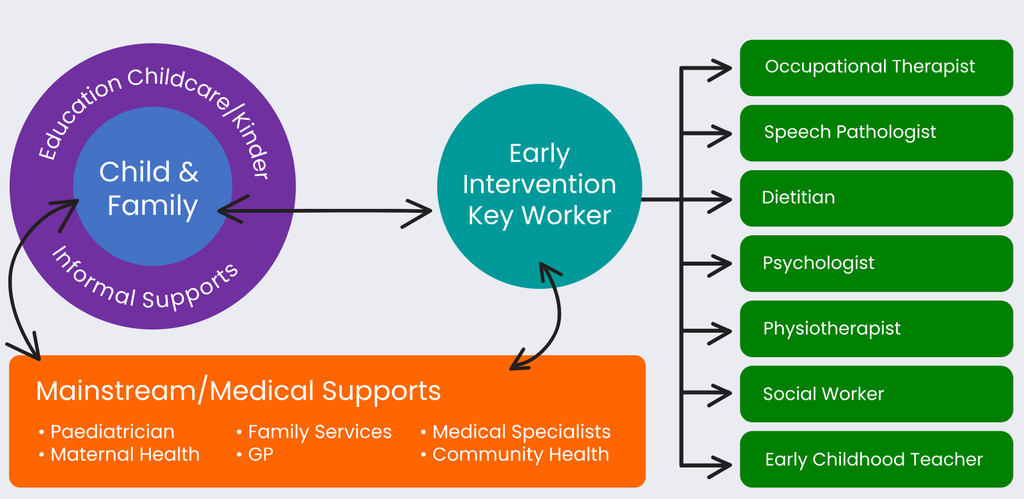
The team works together to build and review your child’s therapy plan, while the Key Worker stays your single point of contact. The Key Worker also connects with your child’s education setting, such as childcare or kinder, and with mainstream and medical supports, such as your GP, paediatrician, maternal health nurse and community health service. The NDIS and experts in the ECEI field consider this transdisciplinary approach best practice.
AYS Key Workers arrange sessions where they suit your family best. Sessions can take place at home, at childcare or kinder, in the community, or in our specially equipped consulting rooms. Practising skills in real routines, like mealtimes, getting dressed and play, helps a child use those skills every day.
Stage 4: Building Family Confidence
Families are the constant in a child’s life. A therapy session lasts an hour, but a child spends the rest of the week at home, at kinder and in the community. The family-centred approach at AYS builds on your strengths and your knowledge of your child. Your Key Worker coaches you to use therapy strategies outside of sessions, so progress continues every day.
Over time, this capacity building has a lasting effect. Parents and carers grow more confident in supporting communication, play, behaviour and self-care. The strategies become part of normal family life, and your child’s progress keeps building long after each session ends.
Stage 5: Reviewing Progress and Adapting the Plan
Children change quickly, so early intervention changes with them. The transdisciplinary team at AYS tracks progress through standardised assessments, observation and your feedback on how your child manages daily routines. Regular reviews show which goals your child has achieved and which new goals to set next.
Sometimes a need falls outside a Key Worker’s scope. AYS therapists with specialised training can provide intensive blocks of therapy through programs including:
- Westmead Feelings Program
- The Astronaut Program
- PECS (Picture Exchange Communication System)
NDIS plan reviews also adjust funded supports as your child’s needs change.
Stage 6: Preparing for School and Beyond
The long-term goal of ECEI is full participation at home, at school and in the community. As children approach school age, early intervention often shifts its focus to school readiness. This includes pre-literacy and pre-numeracy skills, self-care, social skills and emotional regulation.
Early Childhood Teachers and other members of the transdisciplinary team help children build the skills they need for a confident start to school.
Success in early intervention looks different for every child. For one child, success means saying their first words. For another child, success means joining in play at kinder or managing big feelings. Each achievement becomes the foundation for the next stage of life.
Start Early Childhood Early Intervention With AYS
Early support creates lasting progress. Access Your Supports provides Early Childhood Early Intervention for children aged 0 to 7 in Geelong, Colac and surrounding areas.
- Learn more about our Early Childhood Early Intervention service or download the Early Intervention brochure.
- Meet our Early Intervention team.
- Start the process with the ECEI referral form.
Ready to talk about your child’s development?
Contact our team today, and let’s build a plan that grows with your child.